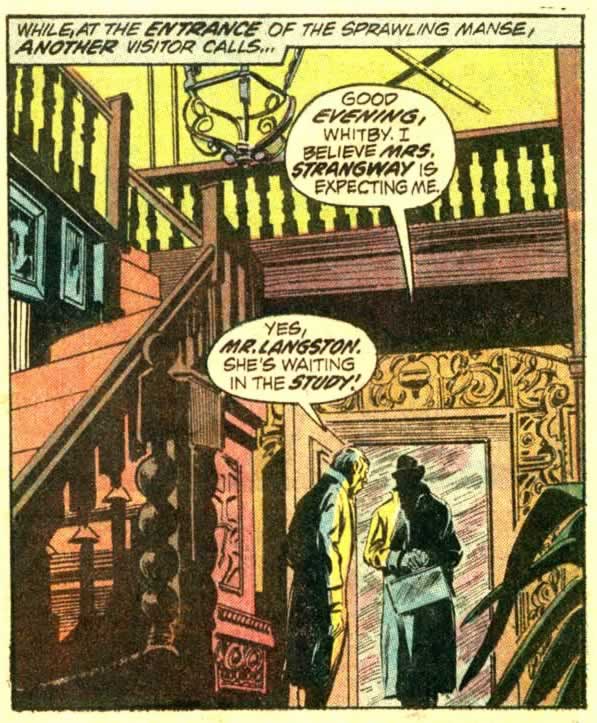
The Tomb of Dracula 4 (September 1972)
 Archie Goodwin's second, and final, issue of The Tomb of Dracula is titled Through a Mirror Darkly! The literary near-allusion is apt: the protagonist of this two part story - Mrs Strangeway - is incapable of seeing what she has in her favour until the book's conclusion, at which time she looks back on her decisions with a sudden clarity; and there's a literal 'dark glass' through which Dracula passes.
In search of her lost youth, Mrs Strangeway believes that becoming a vampire will keep her young. She quotes Bram Stoker to the Count in support of this 'theory', questioning him as to the passage's truth, and bargains with Dracula offering to tell him the secret of the Dark Mirror she has in her collection of occult items. Dracula warns her that "there is worse than ageing", but vanity prevails and the deal is sealed - she gets her wish.
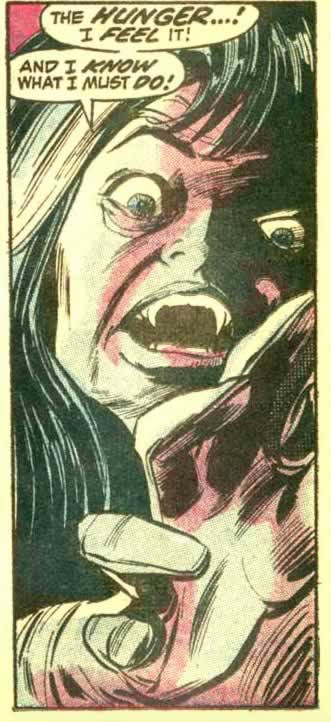 Upon her revival she shares the secret of the Dark Mirror; that it's a portal through time which Dracula could use it to return to the 19th century. Seeming to be unimpressed, he leaves Mrs Strangeway to "reap the reward of being a vampire". Later she realises the truth the comments about ageing when she discovers that she'll only ever be as you as when she first because a vampire. In anger she kills Clifton and then begs to be finished off herself, a final wish that is granted her by Rachel van Helsing.
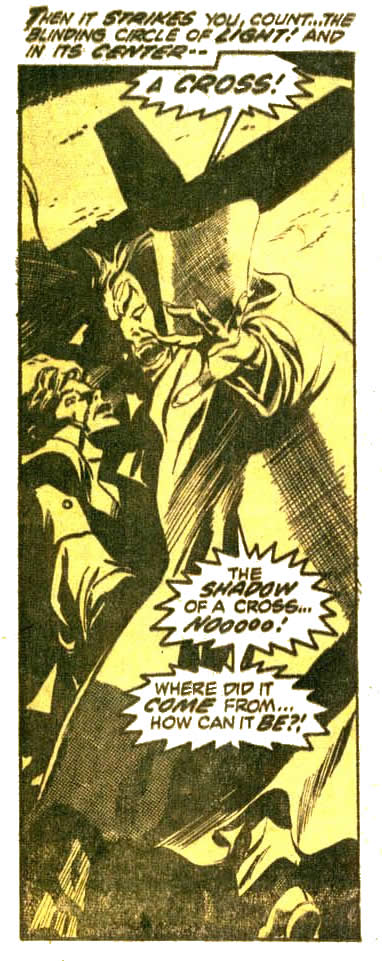
Prior to all this the local police had started to investigate - Mrs Strangeway's servant having been struck down during the earlier events - with the help of the remainder of the regular cast. They'd tracked down Clifton, who was still in Dracula's employ, and then moved on to hunt the Count himself. Dracula cornered and attacked Drake but was driven off by Raj who was armed with a specially adapted torch, one that casts the shadow of a crucifix from its beam.
 The issue concludes with the Count making his way towards the Dark Mirror, intending to escape his pursuers. At the final moment Raj leaps at him. During the grapple the pair of them fall through the mirror - we're left with a final panel of Raj's hand emerging from the mirror's inky surface....
By this fourth issue The Tomb of Dracula was starting to lay the foundation work for the remainder of its run. A large part of the cast are already in place, and the story lines are establishing a template that would be relied upon heavily in later years. Even the creators are mostly in place, with the noticeable exception of a writer. The next issue sees a new author in place, the third in an extremely short period of time.
Despite only working on two issues, Archie Goodwin leaves a long lasting legacy for the title in the form of the characters he's created. Around this period he was scripting a wide variety of books for a number of publishers. Although he wouldn't return to the colour title, Goodwin would continue to turn out the occasional vampire story; earlier in 1972 he'd been working on Vampirella at Warren. Coincidentally the month following his final The Tomb of Dracula saw a reprint in Creepy of a 9-pager he'd done some years earlier titled The Coffin of Dracula.
The Tomb of Dracula 4 sees a near-solid team starting to pull together. The story picks up quickly from the previous issue and moves along at a steady pace. The plot, thin though it may be, works providing disbelief can be suspended for 20 pages, and the art team are already delivering at near the peak of their powers. Palmer's inks suit Colan's pencils perfectly, and that excellent pairing would, with a few breaks, take us through the next five years.
posted by George at 4/15/2007 09:00:00 am
0 comments